
Why this question comes up in Dubai
Between school runs, supermarket stops, and weekend outings, most Dubai families keep water in the car. The problem is that a normal plastic bottle can go warm fast, and in hot months it can taste unpleasant by midday. People then either overpay for constant cold drinks, or they buy a “cooler” product that does not really keep water cold in real use. This guide explains the practical options for keeping car water cold (or at least drinkable), what is worth buying on a budget, and how to avoid the common mistakes that make everything warm too quickly.
Option 1: Insulated bottles (best for one or two people)
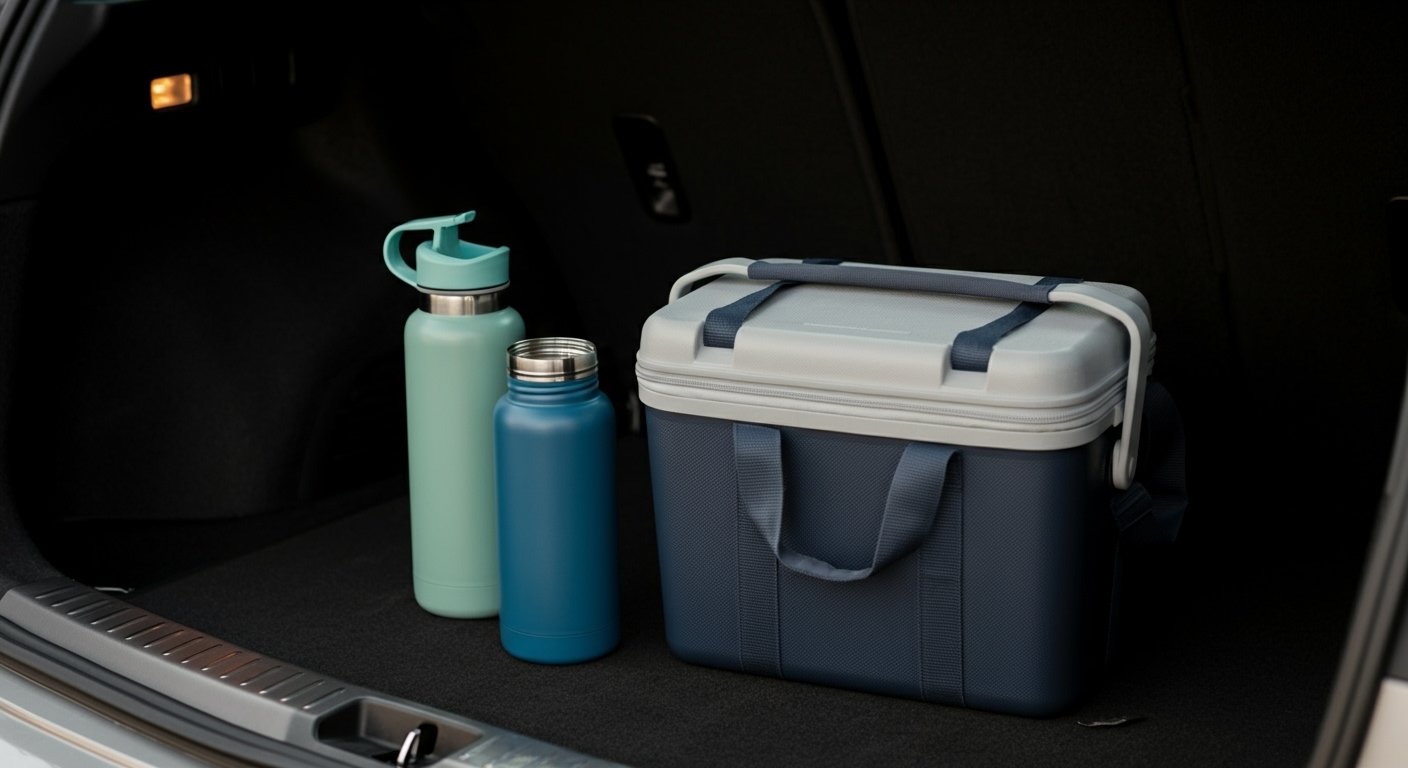
If you only need water for yourself and maybe one child, insulated stainless steel bottles are the simplest answer. The key is choosing a bottle that seals properly and fits your car cup holder. Wide-mouth bottles are easier to clean, but they can be awkward for kids to drink from in the back seat. A flip-top spout or straw lid is usually easier for children, especially on bumpy roads. The budget tip is to buy one or two good bottles rather than a full set, and use them for the daily routine rather than keeping them as “special outing” bottles.
Option 2: A small hard cooler (best for families)
For a reliable family setup, a small hard cooler in the boot is more consistent than a soft bag. It holds temperature better, it is easier to wipe clean, and it does not collapse when loaded with ice and bottles. Choose a size you can actually lift when it is full. A cooler that is too big becomes annoying, and then you stop using it. For most families, a compact cooler plus a few ice bricks is enough for school pickups, errands, and weekend drives.
Option 3: Soft cooler bags (good if you are in and out of the car)
Soft cooler bags are convenient if you move between the car and a park, beach, or sports class. The biggest difference between a good one and a disappointing one is the lining. Look for a leak-resistant lining and strong zips. A bag that leaks melted ice will quickly become a mess in your boot. If you are using a soft bag, keep it out of direct sun and avoid leaving it on a hot seat, which warms it faster than you expect.
Ice bricks vs frozen bottles: what works better
For car water, frozen bottles are one of the easiest budget hacks. They cool everything around them, and later you can drink them as they melt. Ice bricks are more consistent for longer cooling, especially if you are opening the cooler repeatedly. The best approach is often a mix: one or two ice bricks as the base, plus a couple of frozen bottles that you rotate through the day.
The biggest mistake: starting with warm water
No cooler can “create cold” quickly in a hot car. If you pack room-temperature bottles and expect them to chill, you will be disappointed. The easiest fix is starting with cold water from the fridge, or partially freezing bottles overnight. If you are using insulated bottles, fill them with cold water and add a few ice cubes if your lid design allows it without leaking.
Where to keep water in the car (and where not to)
The front seat in direct sun warms bottles fast, even if the air conditioning is on. If you can, keep your water in the boot in a cooler, or in the footwell area where it is less exposed to direct sunlight. If you have kids, a small insulated bottle per child is often the most practical, and the family cooler can hold backup bottles. Also keep a simple rule: do not leave opened drink bottles in the car overnight, especially in hot months.
What to look for when buying on a budget
- For insulated bottles: good seal, easy-to-clean lid, fits cup holder, durable finish
- For coolers: manageable size, easy cleaning, thick walls, sturdy handle
- For ice packs: large flat bricks last longer than thin gel packs
- For daily use: a setup you will actually maintain, not a complicated “perfect” system
Quick wrap-up
For most Dubai families, the most reliable car-water setup is simple: start with cold bottles, keep them in a small cooler with a couple of ice bricks, and use insulated bottles for whoever needs water within reach. The goal is not to build an elaborate system. It is to make sure you always have drinkable water in the car without constantly buying overpriced cold drinks on the go.